We invest exclusively in pre-seed and seed-stage B2B AI startups redefining the global retail and supply chain ecosystem. Beyond capital, we provide founders with an unfair advantage through direct integration into our proprietary network of enterprise decision-makers and global M&A pathways.
An AI-powered post-purchase and returns management platform. By reconstructing a loss-heavy process, Returngo enables brands to preserve revenue, optimize reverse logistics, and dramatically increase customer lifetime value.
A platform engineered for store-tailored demand forecasting and inventory optimization. Intelligent algorithms based on micro-level process mining maintain optimal stock levels and avoid overstock across complex omni-channel locations.
A comprehensive sales intelligence platform that transforms real-time omnichannel data into AI-driven recommendations. Quantia enables instantaneous, automated decision-making for enterprise retail brands seeking competitive dominance.
Seed Stage Investment
Founder Feedback
Built on Trust.
"Placeholder for founder feedback regarding the strategic value, network access, and operational guidance provided by the Rethink team during the scaling phase."
Founder Name
Company Name
"Placeholder for another founder feedback highlighting Rethink ability to connect startups with critical enterprise clients and future capital partners seamlessly."
Founder Name
Company Name
"Placeholder for feedback emphasizing the hands-on practitioner DNA. The partners at Rethink operate more like co-founders who deeply understand the GTM mechanics."
Founder Name
Company Name
"Placeholder concluding with how the unique M&A focus from day one structured the company for a highly lucrative exit matching the vision."
Founder Name
Company Name
Leadership
Built by Operators.
Mudit Rawat
Managing Director
I am a serial entrepreneur and M&A executive with nearly two decades of experience in retail tech. Having successfully scaled and exited companies like Nexus Commerce and Urbery, I focus on helping our founders build the structural integrity needed for global acquisition.
My approach is rooted in capital market foresight and enterprise software scalability. I partner with you to reconstruct GTM mechanics and use my network to pave a clear pathway for lucrative exits.
Yael Kochman
Partner
I am an entrepreneur and marketing leader who co-founded Roojoom, where I pioneered AI content orchestration. My work at Rethink is about bridging the gap between deep tech innovation and market penetration.
I helped lead the ReturnGO exit to Global-e, demonstrating how algorithmic growth engines can dominate a niche. I work intimately with our founders to build data-driven feedback loops that accelerate user acquisition.
Ready to Rethink Commerce?
Whether you are a founder building the next AI core or an LP seeking performance-aligned participation, tell us about your vision.
Strategic Analysis 2026
The Autonomous Agency Shift.
The Action-Oriented Paradigm: The End of Conversational AI
Entering 2026, we are witnessing the terminal shift from conversational AI to action-oriented agentic systems. At Rethink, we define this as the Action-Oriented Paradigm. It is no longer enough for AI to consult; it must possess the reasoning to plan and the technical capability to execute natively. We are specifically backing the infrastructure that enables these agents to operate within legacy retail environments, collapsing 18-month API modernization cycles into under 8 weeks.
Cracking the 60% Integration Barrier: The GUI Strategy
One core component we monitor is the OpenClaw framework—a mission-critical gateway that allows industrial AI to act as an Intelligent Overlay. This technology enables legacy ERP and POS systems to be operated by autonomous agents without invasive software updates. By leveraging Anthropic's Computer Use and similar GUI-perception technologies, agents can now manage merchandising and price adjustments with a 50-millisecond response window, creating a competitive moat that was previously impossible.
Projected Industrial Impact
30%
OPEX Reduction
25%
EBITDA Lift
9x
Velocity Factor
$15T
M2M Market Gap
Agentic Commerce Maturity: From Programmed to Networked
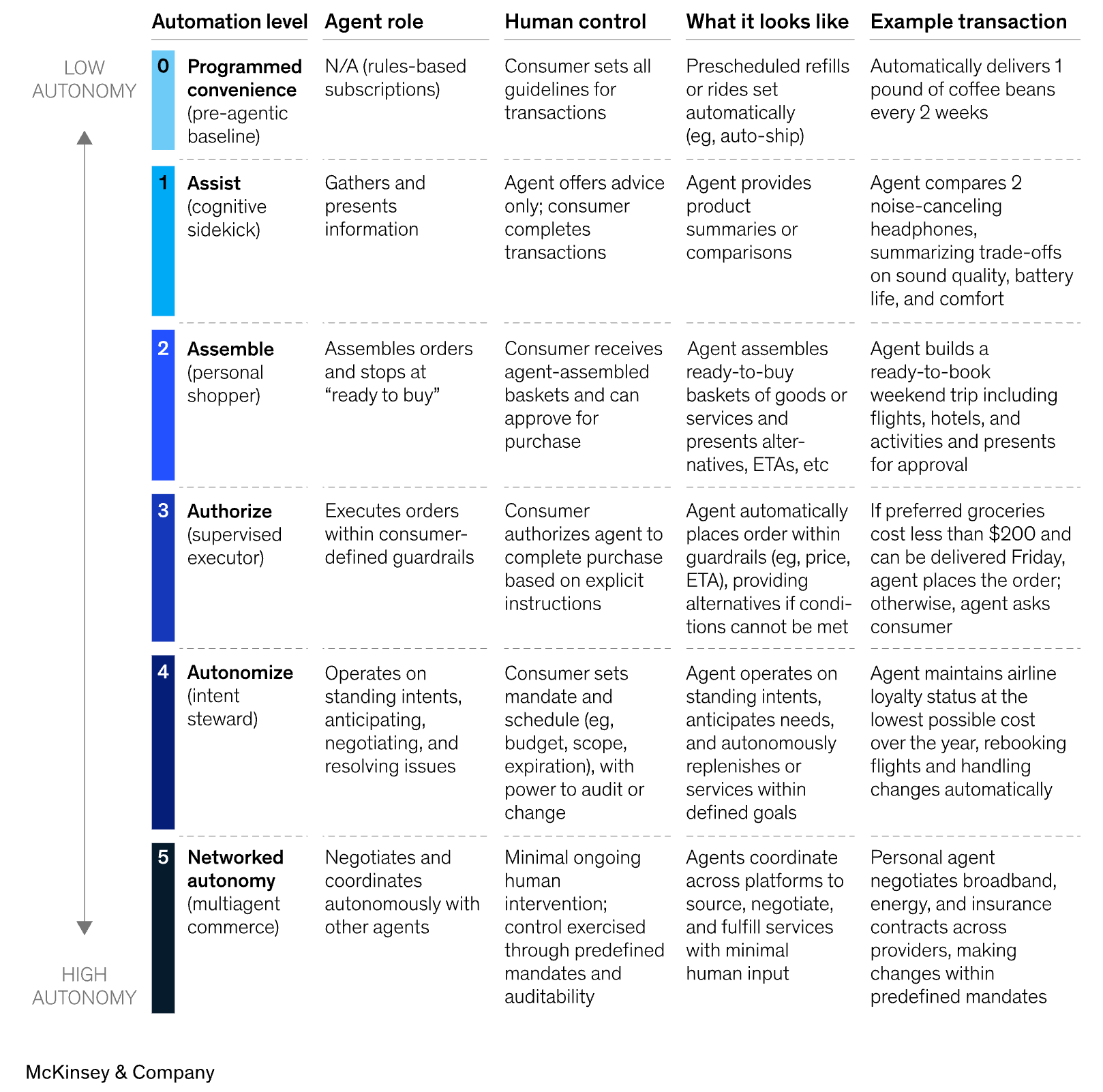
The McKinsey Agentic Commerce model tracks retail evolution from L0 programmed rules to the L5 terminal stage of networked autonomy. Strategic winners are pivoting from authorized execution toward L4 goal-oriented autonomy, where agents manage inventory health and margin optimization without human mediation. The terminal L5 stage facilitates a $15 Trillion Machine-to-Machine industrial fabric, where retail purchasing agents negotiate pricing and demand fulfillment in real-time. This high-frequency operational capacity is the bedrock of Rethink’s EBITDA lift projections, providing a leverage ratio where one orchestration layer replaces ten full-time equivalent operators.
McKinsey Automation Curve Data
Illustration representing L0-L5 maturity transitions in agentic commerce
Merchandising Revolution and Execution Leverage
In practical merchandising, the agentic shift enables proactive inventory governance rather than reactive replenishment. Using real-time media sensor data, agents capture market volatility to execute price adjustments that capitalize on social trends instantaneously. This transition allows procurement teams to recover 40% of their time previously spent on low-value data cleaning, redirecting human capital toward strategic decision-making. The synergy of media intelligence and agentic execution ensures that information flow directly drives industrial response at institutional scale, effectively shortening the path from insight to action by over 60%.
Governance-by-Design: Navigating the Security Epoch
The rapid adoption of agentic frameworks introduces acute security vectors, notably CVE-2026-25253 and the proliferation of Shadow AI within the retail workforce, where over 70% of staff utilize ungoverned tools. Rethink prioritizes a Governance-by-Design architecture, integrating deterministic safety rails within probabilistic planning cycles. By enforcing localized execution through OpenClaw’s gateway model and maintaining human-in-the-loop validation for high-consequence transactions, we mitigate systemic risks while capturing the terminal efficiency of the autonomous epoch. The ability to centralize oversight without sacrificing velocity will define the winners of 2030.
The Dawn of Agentic Commerce & OpenClaw Ecosystem.
I. Investment Summary & Macroeconomic Context
The year 2026 marks a profound paradigm shift in global commercial infrastructure. The experimental phase of Generative AI has officially concluded, replaced by the widespread deployment of "Agentic AI" focused on execution and autonomy. In this process, the viral outbreak of the open-source agent framework OpenClaw has fundamentally disrupted the underlying logic of Retail Tech, digital advertising, and payment networks.
Macro data indicates that by 2030, U.S. retail e-commerce sales are projected to reach $1.8 trillion (29% of total retail sales), while the global retail tech market will expand at a CAGR of 12.7% to $49.2 billion. The U.S. Smart Retail market alone is projected to hit $86.8 billion by 2033. Consequently, AI-driven shopping assistants are expected to command up to $1 trillion of U.S. B2C e-commerce sales by 2030, coordinating an astounding $5 trillion in global transaction volume.
II. Restructuring Commercial Logic: The Shopper Schism
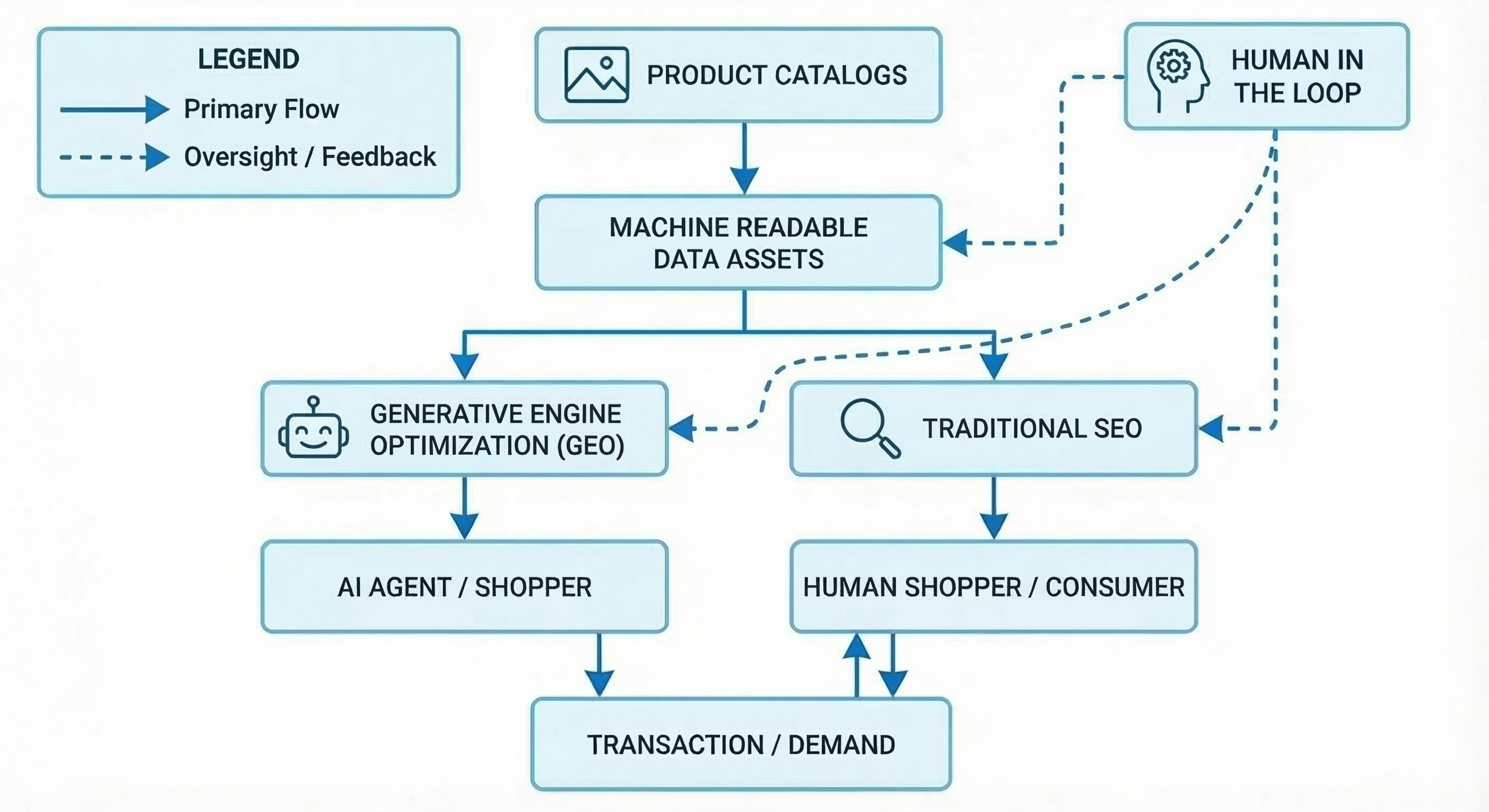
The rise of Agentic Commerce fractures a century-old microeconomic assumption: that the "Consumer" (who dictates demand and uses the product) and the "Shopper" (who searches, compares, and transacts) are the same entity. As AI agents assume the role of the shopper, digital advertising budgets are migrating from traditional SEO towards Generative Engine Optimization (GEO). Brands must now convert product catalogs into machine-readable data assets.
Agentic Architecture Mapping Placeholder
III. The OpenClaw Phenomenon
OpenClaw (formerly Clawdbot), created by former PSPDFKit founder Peter Steinberger, has gathered over 250,000 GitHub stars, transitioning systems from conversational AI to action-oriented AI. It acts as a local gateway bridging LLMs with local file systems, browsers, and terminal commands. Its architecture features persistence mechanisms (Cron scheduling) and localized memory, while its "Skills" module ecosystem acts as pre-packaged execution logic.
Customer service automation, seamless consumer channel docking, automated ticket distribution.
Knowledge & Memory Mgmt
Internal corporate knowledge retrieval, order queries, personalized context retention.
Self-Improvement Guardrails
Autonomous error handling, defense against prompt injection, transaction securing.
Industry Research Report
Infrastructure Wars & VC Landscape.
IV. The Infrastructure War: UCP vs. ACP
As AI agents gain product discovery capabilities, seamless payment execution is the final hurdle. 2026 is witnessing a standard war between Google's Universal Commerce Protocol (UCP) and OpenAI's Agentic Commerce Protocol (ACP), dictating future retail traffic and digital wallet allocation.
Dimension
OpenAI ACP
Google UCP
Underlying Logic
Centralized (Platform as gateway); Agent is absolutely dominant.
Persistent sessions extending to order tracking and post-sale.
V. Systemic Risks & KYA Framework
Granting autonomous AI financial execution introduces profound risks. OpenClaw exposed vulnerabilities like CVE-2026-25253, allowing bypassed sandboxes. Consequently, NIST and Mastercard are advancing the "Know Your Agent" (KYA) framework, necessitating cryptographic fingerprinting for agents and rigid human-in-the-loop sandboxing for high-value transactions.
VI. VC Landscape & The Toronto Structural Arbitrage
Venture capital is pivoting towards infrastructure and empirical ROI, revealing a polarized K-shaped recovery. Foundation models command >100x revenue multiples, while customized agent wrappers face severe compression. Crucially, the Toronto ecosystem presents a rare structural arbitrage opportunity. Despite high AI talent density, Canadian seed rounds are 40% smaller than U.S. counterparts.
Investment Category
Revenue Multiple
Market Driver
Seed / Early Stage
10x – 25x
Median pre-money at $10M. Demands clear PMF and revenue traction.
Developer Infrastructure
26x – 35x
Viewed as novel SaaS with high stickiness; enjoys stable premiums.
Foundation Models
100x+
Relies on capital-intensive moats to form monopoly expectations.
VII. Actionable Strategy
Rethink.vc must prioritize capital in "Protocol & Middleware Infrastructure" bridging UCP/ACP, fund cybersecurity firms tackling "Agentic Security & KYA," and harvest the "Toronto Valuation Basin" by deploying research teams to intercept pre-Series A startups focused on supply chain automation.